At Portcullis Surgery there is no longer a requirement to wear face masks in all clinical environments.
Masks are not required in non-clinical areas (corridors, offices etc.), however both staff and patients may continue to wear one in all areas of the premises if they prefer.
It is advised that Type IIR fluid-repellent surgical masks continue to be worn in the following circumstances:
By staff when with patients with a confirmed or suspected respiratory infection
By staff who have any respiratory symptoms but who feel well enough to work
By staff when with patients who are immunocompromised e.g. transplant or haemato-oncology patients. PLEASE ASK THE RECEPTION TEAM AT THE MOMENT OF BOOKING YOUR APPOINTMENT TO LET THE CLINICIAN KNOW THAT YOU WOULD LIKE THEM TO WEAR A MASK.
Staff should also wear a mask if this is the patient’s preference. PLEASE ASK THE RECEPTION TEAM AT THE MOMENT OF BOOKING YOUR APPOINTMENT TO LET THE CLINICIAN KNOW THAT YOU WOULD LIKE THEM TO WEAR A MASK.
Face masks will be provided at the reception waiting area, please ask a member of staff if you need one. If your appointment is not urgent and you are unwell and suffering from any infection, including a cold, flu, sore throat, diarrhoea, vomiting or a chest infection please call the practice and reschedule your non-urgent appointment for another day.
Use of Benzodiazepines (and related medications) for flying
Use of Benzodiazepines (and related medications) for flying
Diazepam in the UK is a Class C/Schedule IV controlled drug. The following short guide outlines the issues surrounding its use with regards to flying and why the surgery no longer prescribes such medications for this purpose.
People often come to us requesting the doctor or nurse to prescribe diazepam for fear of flying or assist with sleep during flights. Diazepam is a sedative, which means it makes you sleepy and more relaxed. There are a number of very good reasons why prescribing this drug is not recommended.
According to the prescribing guidelines doctors follow (British National Formulary) diazepam is contraindicated (not allowed) for treating phobias (fears). It also states that “the use of benzodiazepines to treat short-term ‘mild’ anxiety is inappropriate.” Your doctor would be taking a significant legal risk by prescribing against these guidelines. They are only licensed short term for a crisis in generalised anxiety. If this is the case, you should be getting proper care and support for your mental health and not going on a flight. Fear of flying in isolation is not a generalised anxiety disorder.
Although plane emergencies are a rare occurrence there are concerns about reduced awareness and reaction times for patients taking Diazepam which could pose a significant risk to themselves and others due to not being able to react in a manner which could save their life in the event of an emergency on board necessitating evacuation.
The use of such sedative drugs can make you fall asleep, however when you do sleep it is an unnatural non-REM sleep. This means you won’t move around as much as during natural sleep. This can cause you to be at an increased risk of developing a blood clot (Deep Vein Thrombosis – DVT) in the leg or even the lungs. Blood clots are very dangerous and can even prove fatal. This risk is even greater if your flight is greater than 4 hours, the amount of time which has been shown to increase the risk of developing DVT whether in an aeroplane or elsewhere.
Whilst most people find Diazepam sedating, a small number have paradoxical agitation and aggression. They can also cause disinhibition and lead you to behave in a way that you would not normally which can pose a risk on the plane. This could impact on your safety as well as that of other passengers and could also get you into trouble with the law. A similar effect can be seen with alcohol, which has led to people being removed from flights.
Diazepam and similar controlled drugs are illegal in a number of countries. They may be confiscated or you may find yourself in trouble with the police. The passenger may also need to use a different strategy for the homeward bound journey and/or other legs of the journey
It is important to declare all medical conditions and medications you take to your travel insurer. If not, there is a risk of nullifying any insurance policy you may have.
Given the above we will no longer be providing Diazepam or similar drugs for flight anxiety and instead suggest the below aviation industry recommended flight anxiety courses.
Flight anxiety does not come under the remit of General Medical Services as defined in the GP contract and so we are not obliged to prescribe for this. Patients who still wish to take benzodiazepines for flight anxiety are advised to consult with a private GP.
All UK medical schools now require applicants to have experience in a caring or service role, either paid or voluntarily, in health or related field, as well as direct observation healthcare. Portcullis is very keen to promote students to follow a career in Medicine, Nursing or related fields and we are more than happy to accept students for work experience at the practice.
Work experience is incredibly useful for finding out if you’re suited to medicine and where your specialty interests may lie. It also shows your commitment to becoming a doctor and is a valuable part of your medical school application.
You can get a placement in a range of healthcare settings, such as a GP practice, hospital or even internationally.
What do you need to do to get a placement at Portcullis Surgery?
You will need to be at least 16-years-old for a work placement at our practice.
We will give priority to local students if demand is very high.
We prefer placements to be in the summer months June-September as the practice is less busy then.
Send an email to the practice for the attention of Dr Catherine Beanland and we will be in touch. Please give us some information about yourself and what your career plans and interests are so we can tailor the experience to your needs.
Top tips when on a placement at Portcullis Surgery
Dress smartly we would like students to wear black trousers or skirt and a white, black or red top. Alternatively if you have them you can wear scrubs.
Be aware that some patients may wish to be seen without a student present. Don’t take this personally.
Remember that patient confidentiality is important. You must not, under any circumstances, discuss patient issues outside of the department or practice you are based in. Be aware that you will be asked to sign a confidentiality agreement.
It would be inappropriate for you to see a patient that is known to you socially, whether it be a family member or friend. If this happens you should tell the person who is supervising you and leave the room.
Make sure you tell your placement what you expect to get out of it and let them know if there is anything that you would like to do or learn whilst you’re there.
Keep a log/ daily diary of what you did and saw. This can help solidify what you learn, but is also an important reference tool when you are writing a personal statement and preparing for your medical school interviews.
Try to speak to a diverse range of staff. Time with other healthcare workers can offer a great insight into the multi-disciplinary approach to healthcare.
Ask questions and show enthusiasm. Ask the doctors about what they think are the qualities of a good doctor, ask them about their work patterns, lifestyle or whether they would choose medicine again as a career.
Talk to patients – remember to be polite and introduce yourself as a medical school applicant on work experience.
Be proactive and offer a pair of helping hands at every opportunity.
Patient Participation Group and Surgery Equipment and Carer’s Group Fund
We want to ensure patients, their families and carers are represented and heard from at all stages of their treatment at our practice.
We have a Patient Participation Group chaired by Mr Alistair Barton
What is a PPG?
Patient Participation Groups (PPGs) are generally made up of a group of volunteer patients, the practice manager and one or more of the GPs from a practice. PPGs meet on a regular basis to discuss the services on offer, and how improvements can be made for the benefit of patients and the practice.
If you would like to join the Patient Participation Group please email our Duty Manager (portcullis.dutymanager@nhs.net) who will put you in contact with our Chair Alistair.
The PPG have a surgery equipment fund aswell as a Carers group fund for all donations received, which is governed by some of our patients for the benefit of the practice.
The money donated to the surgery fund is greatly appreciated as it enables us to buy equipment that would not normally be available for our surgery.
We try to buy equipment that will be of benefit to the wide range of our patients.
From donations received, the equipment fund is able to purchase the following types of equipment and services:
Portable oxygen for the Doctors’ cars
Replacement canisters for Cryotherapy
Spirometer machine
Oxygen saturation monitors for loaning to patients
Blood pressure monitors for loaning to patients
Financial help needed for our volunteers to visit our patients in our befriending scheme
Funding for carers group activities
Our sincere thanks to everyone who has helped us make these purchases and services possible.
Donations
If you would like to make a donation to the Medical Practice Equipment Fund or the Medical Practice Carers Group Fund then please either make a cheque payable to ‘Portcullis Surgery’ or we are happy to accept cash and coin collections and place it in an envelope marked for the attention of our Practice Manager Mrs Rachel Wilding specifying if your donation is a general fund donation or a specific donation for the carers group fund.
If you prefer you can make donations anonymously, otherwise please ensure we have the details of whom the donation is from (or on behalf of) as we always like to write and thank all who donate.
We will then pass your donation to the Treasurer of the Surgery Equipment Fund so they can contact and thankyou.
Privacy Policy for Data Sharing and Analysis
OpenSAFELY COVID-19 Service and the OpenSAFELY Data Analytics Service.
NHS England has been directed by the government to establish and operate the OpenSAFELY COVID-19 Service and the OpenSAFELY Data Analytics Service.
These services provide a secure environment that supports research, clinical audit, service evaluation and health surveillance for COVID-19 and other purposes.
Each GP practice remains the controller of its own GP patient data but is required to let approved users run queries on pseudonymised patient data. This means identifiers are removed and replaced with a pseudonym.
Only approved users are allowed to run these queries, and they will not be able to access information that directly or indirectly identifies individuals.
Patients who do not wish for their data to be used as part of this process can register a type 1 opt out with their GP.
(This Privacy Notice is to run alongside our standard Practice Privacy Notice)
Due to the unprecedented challenges that the NHS and we, Portcullis Surgery face due to the worldwide COVID-19 pandemic, there is a greater need for public bodies to require additional collection and sharing of personal data to protect against serious threats to public health.
In order to look after your healthcare needs in the most efficient way we, Portcullis Surgery may therefore need to share your personal information, including medical records, with staff from other GP Practices including Practices within our Primary Care Network, as well as other health organisations (i.e. Clinical Commissioning Groups, Commissioning Support Units, Local authorities etc.) and bodies engaged in disease surveillance for the purposes of research, protecting public health, providing healthcare services to the public and monitoring and managing the Covid-19 outbreak and incidents of exposure.
The Secretary of State has served notice under Regulation 3(4) of the Health Service (Control of Patient Information) Regulations 2002 (COPI) to require organisations to process confidential patient information in the manner set out below for purposes set out in Regulation 3(1) of COPI.
Purpose of this Notice
The purpose of this Notice is to require organisations such as Portcullis Surgery to process confidential patient information for the purposes set out in Regulation 3(1) of COPI to support the Secretary of State’s response to Covid-19 (Covid-19 Purpose). “Processing” for these purposes is defined in Regulation 3(2) and includes dissemination of confidential patient information to persons and organisations permitted to process confidential patient information under Regulation 3(3) of COPI. This Notice is necessary to require organisations such as Portcullis Surgery to lawfully and efficiently process confidential patient information as set out in Regulation 3(2) of COPI for purposes defined in regulation 3(1), for the purposes of research, protecting public health, providing healthcare services to the public and monitoring and managing the Covid-19 outbreak and incidents of exposure.
Requirement to Process Confidential Patient Information
The Secretary of State has served notice to recipients under Regulation 3(4) that requires Portcullis Surgery to process confidential patient information, including disseminating to a person or organisation permitted to process confidential patient information under Regulation 3(3) of COPI.
Portcullis Surgery is only required to process such confidential patient information:
where the confidential patient information to be processed is required for a Covid-19 Purpose and will be processed solely for that Covid-19 Purpose in accordance with Regulation 7 of COPI
from 20th March 2020 until 30th September 2020.
Covid-19 Purpose.
A Covid-19 Purpose includes but is not limited to the following:
understanding Covid-19 and risks to public health, trends in Covid-19 and such risks, and controlling and preventing the spread of Covid-19 and such risks
identifying and understanding information about patients or potential patients with or at risk of Covid-19, information about incidents of patient exposure to Covid-19 and the management of patients with or at risk of Covid-19 including: locating, contacting, screening, flagging and monitoring such patients and collecting information about and providing services in relation to testing, diagnosis, self-isolation, fitness to work, treatment, medical and social interventions and recovery from Covid-19
understanding information about patient access to health services and adult social care services and the need for wider care of patients and vulnerable groups as a direct or indirect result of Covid-19 and the availability and capacity of those services or that care
monitoring and managing the response to Covid-19 by health and social care bodies and the Government including providing information to the public about Covid-19 and its effectiveness and information about capacity, medicines, equipment, supplies, services and the workforce within the health services and adult social care services
delivering services to patients, clinicians, the health services and adult social care services workforce and the public about and in connection with Covid-19, including the provision of information, fit notes and the provision of health care and adult social care services
research and planning in relation to Covid-19.
Recording of processing
A record will be kept by Portcullis Surgery of all data processed under this Notice.
Sending Public Health Messages
Data protection and electronic communication laws will not stop Portcullis Surgery from sending public health messages to you, either by phone, text or email as these messages are not direct marketing.
Digital Consultations
It may also be necessary, where the latest technology allows Portcullis Surgery to do so, to use your information and health data to facilitate digital consultations and diagnoses and we will always do this with your security in mind.
Research and Pandemic Planning
The Secretary of State has directed NHS Digital to collect, process and analyse data in connection with COVID-19 to support the Secretary of State’s response to COVID-19 and support various COVID-19 purposes set out in the COVID-19 Public Health Directions 2020, 17 March 2020 (as amended) (COVID-19 Direction) and below. This enables NHS Digital to collect data and analyse and link the data for COVID-19 purposes with other data held by NHS Digital.
The purpose of the data collection is also to respond to the intense demand for General Practice data to be shared in support of vital planning and research for COVID-19 purposes, including under the general legal notice issued by the Secretary of State under Regulation 3(4) of the Health Service (Control of Patient Information) Regulations 2002 (COPI).
NHS Digital has therefore been requested by the joint co-chairs of the Joint GP IT Committee (JGPITC) (the BMA and RCGP) to provide a tactical solution during the period of the COVID-19 pandemic to meet this demand and to relieve the growing burden and responsibility on General Practices. On 15 April 2020 the BMA and RCGP therefore gave their support via JGPITC to NHS Digital’s proposal to use the General Practice Extraction Service (GPES) to deliver a data collection from General Practices, at scale and pace, as a tactical solution to support the COVID-19 response in the pandemic emergency period.
It is a requirement of the JGPITC that all requests by organisations to access and use this data will need to be made via the NHSX SPOC COVID-19 request process, that will triage and prioritise these requests and refer appropriate requests on to the NHS Digital Data Access Request Service (DARS). NHS Digital will consult with representatives of the BMA and the RCGP on all requests for access to the data. An outline of the process for this agreed with the BMA and the RCGP is published here. Requests by organisations to access record level data from this collection will also be subject to Independent Group Advising on the Release of Data (IGARD) consideration. Data applicants will need to demonstrate they have a lawful basis to access the data for COVID-19 purposes.
Benefits of this sharing
Organisations, including the Government, health and social care organisations and researchers need access to this vital data for a range of COVID-19 purposes, to help plan, monitor and manage the national response to the COVID-19 pandemic, which will help save lives. COVID-19 purposes for which this data may be analysed and used may include:
understanding COVID-19 and risks to public health, trends in COVID-19 and such risks, and controlling and preventing the spread of COVID-19 and such risks
identifying and understanding information about patients or potential patients with, or at risk of COVID-19, information about incidents of patient exposure to COVID-19 and the management of patients with or at risk of COVID-19 including: locating, contacting, screening, flagging and monitoring such patients and collecting information about and providing services in relation to testing, diagnosis, self-isolation, fitness to work, treatment, medical and social interventions and recovery from COVID19
understanding information about patient access to health services and adult social care services as a direct or indirect result of COVID-19, and the availability and capacity of those services • monitoring and managing the response to COVID-19 by health and social care bodies and the Government including providing information to the public about COVID-19 and its effectiveness and information about capacity, medicines, equipment, supplies, services and the workforce within the health services and adult social care services
delivering services to patients, clinicians, the health services and adult social care services workforce and the public about and in connection with COVID-19, including the provision of information, fit notes and the provision of health care and adult social care services; and
research and planning in relation to COVID-19.
Where it is necessary for us to collect information and specific health data about visitors to our practice, we will not collect more information than we need, and we will ensure that any information collected is treated with the appropriate safeguards.
We have an obligation to protect our staff and employees’ health, so it is reasonable for staff at Portcullis Surgery to ask any visitors to our practice to tell us if they have visited a particular country, or are experiencing COVID-19 symptoms. This must only be in pre-approved circumstances and we would also ask all patients to consider government advice on the NHS 111 website and not attend the practice.
Visitors to The Practice
This information is required by NHS Digital under section 259(1)(a) of the 2012 Act to comply with the COVID-19 Direction. In line with section 259(5) of the 2012 Act, all organisations in England that are within the scope of this Notice, as identified below under Health and Social Care Bodies within the scope of the collection, must comply with the requirement and provide information to NHS Digital in the form, manner and for the period specified in this Notice. This Notice is issued in accordance with the procedure published as part of NHS Digital’s duty under section 259(8) of the 2012 Act.
Details of the information to be collected can be found on the NHS Digital website – Specification of this DPN. Type 1 objections will be upheld in collecting this data from General Practices and therefore the data for those patients who have registered a Type 1 objection with their GP will not be collected. The Type 1 objection prevents an individual’s personal identifiable confidential information from being shared outside of their GP Practice except when it is being used for the purposes of their direct care. The National Data Opt-Out will not apply to the collection of the data, as this is a collection which is required by law.
NHS Digital has been directed by the Secretary of State under section 254 of the 2012 Act under the COVID-19 Direction to establish and operate a system for the collection and analysis of the information specified for this service: GPES Data for Pandemic Planning and Research (COVID-19). A copy of the COVID-19 Direction is published here: https://digital.nhs.uk//about-nhs-digital/corporate-information-and-documents/directions-anddata-provision-notices/secretary-of-state-directions/covid-19-public-health-directions-2020.
Legal Basis for this collection
Data will be collected nationally from all GP Practices by NHS Digital every fortnight. All requests to access this data will be triaged through the NHSX SPOC COVID-19 request process and assessed and fulfilled by NHS Digital through DARS. This will significantly reduce the burden on General Practice at a time when demand on resources is high, enabling General Practice to focus on delivering health care and support to patients. It will also reduce compliance burden and risk for General Practice associated with sharing data and complying with the terms of the general legal notice issued under COPI, which applies to General Practices.
Data may be analysed and linked to other data held by NHS Digital or held by other organisations to which access to the data is granted for COVID-19 purposes, through the process described above.
Review and Expiry of this Notice
This Notice will be reviewed on or before 30 September 2020 and may be extended by The Secretary of State. If no further notice is sent to Portcullis Surgery by The Secretary of State this Notice will expire on 30 September 2020.
Patient Access to Online Records and Access to your Medical Records
From 4th October 2023, most of our patients over 16 can see any new information added to their health record. This includes notes from your GP appointments, test results, medications, and letters from hospitals added to your record since 4th October 2023. This means that you will be able to see any notes from your appointments with your GP, as well as test results and any letters that are saved on your records.
This only applies to records from your doctor (GP), not from hospitals or other specialists. For most people, access will be automatic, and you won’t need to do anything. General practice will be able to customise or remove access for individuals if this is deemed inappropriate.
You can view this via the NHS App, NHS website, or another GP online app you use.
Medical Disclaimer regarding Online Access to Notes
The health information on your patient access notes is intended for use solely by patients. If you are ever in any doubt about information you read or you are unsure what to do, you should email us with your question on the link below. While every effort has been made to ensure that the information contained in your online records is correct and up-to-date, this cannot be guaranteed. The Practice cannot be held responsible for harm, loss or damage resulting from inaccuracies in their patients online records, or actions taken by persons in response to reading information on their medical records.
If you don’t want to be able to see your record, send us a message to let us know that you do not wish to see your records.
For non-urgent enquiries about your medical notes, we reserve the right to take upto 40 working days (2 months) to answer any questions you may have about your online records.
The Practice reserves the right to change its systems and procedures at any time without notice
Send us a message about your concern or query regarding your medical records on the link below:
Only patients over the age of 16 will be allowed to have full online access to their notes. Proxy access for parents may be allowed for patients on or under the age of 12 years of age following a request. (see online access registration to download consent form needed for proxy access)
Use of your security details by an unauthorised person may allow them access to confidential medical information about you; therefore these details must be kept confidential at all times.
Your security details must be kept safe and secure at all times. Patients must NOT share their security details to any other person including family and practice staff. We will NEVER ask you for your security details. If someone asks you for these details please inform the practice immediately.
You must use all reasonable precautions to protect your security details. This includes not using a public computer for access to the service and using the log off icon when you have finished with the service.
Some of the problems regarding online access to records-Concerns about Safeguarding
While enabling patients to view their medical records through the NHS App will be beneficial to the majority of patients, there may be challenges for a minority. This is especially true in relation to safeguarding vulnerable adults, as the record may contain information that is confidential and sensitive, which the patient must not see, or could be harmful if the patient is unable to keep their record secure, such as in cases of coercion.
The importance of safeguarding patients from harm is paramount. It may be appropriate to redact specific information entered into the GP medical record or prevent the patient from having access. Harmful and confidential third-party information needs to be redacted as it is being entered into systems.
Ahead of the change, where there may be safeguarding concerns, healthcare workers can prevent patients from having automatic access to new information by adding a code to their record.
Records with the code “Enhanced review indicated before granting access to your own health record” will be excluded from the changes if applied before switch-on.
They should then be reviewed on a case-by-case basis to identify if access can be provided without a risk of serious harm. A code will only work automatically before the switch-on. Applying a code after the change or switch-on will not automatically exclude access; this must be done manually on the record access settings.
Removal or redaction/partial access of Online Access to records
The practice reserves the right to remove or partially remove online access to any patient who abuses or fails to follow any of these guidelines. Abuse of the system includes, but is not exclusive to, the following:
Repeatedly sending needless, repetitive or abusive messages to the practice.
Repeatedly booking and cancelling appointments.
Repeatedly booking appointments and not attending them.
Any kind of foul or abusive language being sent through any of the services.
Booking appointments for patients other than the owner of the account. It is not permitted to book an appointment through an account for a different person to attend.
Repeatedly requesting prescriptions that you do not need.
There are certain circumstances in which full access to a patient’s health record may be denied. These include cases where the release is likely to cause serious harm to the physical or mental health of the subject or another individual.
The practice reserves the right to remove access or limit information from their online records service to any patient who we believe may suffer harm from having automatic access to their online patient records. This includes, but is not exclusive to, the following:
Patients we have significiant safeguarding concerns about or who could be subject to coercion due to their health or any other vulnerable status.
Patients who have significant amounts of third party information in their notes relating to other family members.
Patients who are known to suffer from health related anxiety or any other significant mental health concerns or issues and who may suffer as a result of having online open access to their records.
Patient who lack capacity and are unable to understand how to keep their data safe. Proxy access may be allowed in these circumstances to official guardians.
Patients who have had a recent diagnosis which has not yet been explained to them in detail by either the consultant to a GP.
Access to your full Retrospective and Prospective Records prior to aswell as post 4th October 2023
You have the right to know what information we hold about you. All manual and computerised health records about living people are accessible under the Data Protection Act 1998.
Competent patients may apply for access to their own records, or may authorise a third party, such as their lawyer, to do so on their behalf.
Parents may have access to their child’s records if this is in the child’s best interests and not contrary to a competent child’s wishes.
People appointed by a Court to manage the affairs of mentally incapacitated adults may have access to information necessary to fulfil their function. There are exemptions to this service.
Please send us a message if you wish to see or obtain a copy of your record. If you are referred to a hospital specialist you are also welcome to request a copy of the referral letter. A fee (up to £50) may be charged depending on the type of record and whether you require any copies.
We ask you for information about yourself so that you can receive the best possible care and treatment.
We keep this information, together with details of your care, to ensure that your doctor or nurse has accurate and up to date information it also may be needed if we see you again. We only pass information on about you to people who have a genuine need for it. Whenever we can we shall remove details that identify you as an individual.
Everyone working for the NHS has a legal duty to maintain the highest level of confidentiality about patient information. If at any time you would like to know more about how we use your information you can speak to our Practice Manager.
We respect your right to privacy and keep all your health information confidential and secure.
NHS Care Data Programme
Information about you and the care you receive is shared, in a secure system, by healthcare staff to support your treatment and care. It is important that the NHS keeps accurate and up-to-date records about your health and treatment so that those treating you can provide the best possible care.
It is important that the NHS can use this information to plan and improve services for all patients.
The NHS would like to link information from all the different places where you receive care, such as your GP, hospital and community service, to help us provide a full picture. This will allow the NHS to compare the care you received in one area against the care you received in another, so the NHS can see what has worked best.
Information such as your postcode and NHS number, but not your name, will be used to link your records in a secure system, so your identity is protected. Information which does not reveal your identity can then be used by others, such as researchers, and those planning health services, to make sure the NHS provides the best possible care for everyone. How your information is used and shared is controlled by law and strict rules are in place to protect your privacy. If you do not want information to be shared outside your GP practice, please complete the patient opt out form which is available at reception.
We have a fully computerised medical record system which means information about your healthcare is held on a secure server.
Complaints Procedure
Occasionally things do not go as smoothly as we would like. This is often due to matters beyond our control, such as emergencies. We offer a Practice Complaints Procedure to deal with comments, suggestions, and complaints about the service we provide. Our Practice Manager will give you further information. Our aim is to give you the highest possible standard of service and we try to deal swiftly with any problems that may occur.
The Parliamentary & National Health Service Ombudsman
Millbank Tower
Millbank
London, SW19 4QP
Email: phso.enquiries@ombudsman.org.uk
Tel: 0345 015 4033
The complaints procedure should ensure all complaints are dealt with swiftly and fairly and hopefully to the satisfaction of all concerned.
Policy on Violent or Abusive behaviour
This Practice adopts a ZERO TOLERANCE approach to violence and aggression. Aggressive and violent behaviour is considered to be any personal, threatening or abusive language (cursing or swearing), gestures (including sexual), physical contact, derogatory sexual or racial remarks, shouting at any persons or applying force to any Practice property or the property of any persons within the Practice. This includes people banging on desks or counters or shouting loudly in an intimidating manner.
This approach applies to any patients, visitors and any persons working within the Practice demonstrating any of the above behaviour towards patients, visitors or staff. The Partners are committed to doing everything possible to protect Staff, patients and visitors from unacceptable behaviour and to support zero tolerance to any incident that causes hurt, alarm, damage or distress. It also applies to any Partner or Employee of the Practice whilst on duties away from the Surgery if their duties are related to the business of the Practice.
Patients who are violent or aggressive towards any person on Surgery premises will be removed from the Practice list.
GP Net Earnings
Publication of GP Net Earnings
All GP practices are required to declare the mean earnings (e.g. average pay) for GPs working to deliver NHS services to patients at each practice.
The average pay for GPs working in Our Health Partnership in the last financial year was £48,098 before tax and National Insurance. This is for 47 full-time GPs, 196 part-time GPs and 111 Locum GPs who worked in the practice for more than six months.
This guide tells you what to expect from Portcullis Surgery and how you can help them, so you get the best from the National Health Service (NHS).
According to our contract GP practices are required to have shared a link to the NHS England YYGP document on their practice website home page no later than 1 October 2025. We have set out a personalised Charter for Portcullis patients in the information below:
When and how can you contact your general practice?
Portcullis Surgery doors are normally open between 8.00am and 6.30pm everyday. Please note at certain times, e.g. lunch or the ends of the day, a clinician may not be present in this building.
Our contracted hours are Monday to Friday 08:00 – 18:30. Calls will be answered at these times however any calls after 6pm will be answered by the Out of Hours service, currently Health Hero.
On Thursdays the practice is open for pre-booked appointments only until 8pm. We also have pre-booked online and telephone consultations on other evenings and some Saturdays of the month with our Doctors, nurses and counsellors.
You, or your carer on your behalf, can:
Visit the practice Our doors are normally open between 8.00 and 6.30pm everyday. Please note at certain times, e.g. lunch or the ends of the day, a clinician may not be present in this building.
Call us on 01584 872939 Our contracted hours are Monday to Friday 8am – 6.30pm. Calls will be answered at these times however any calls after 6pm will be answered by the Out of Hours service.
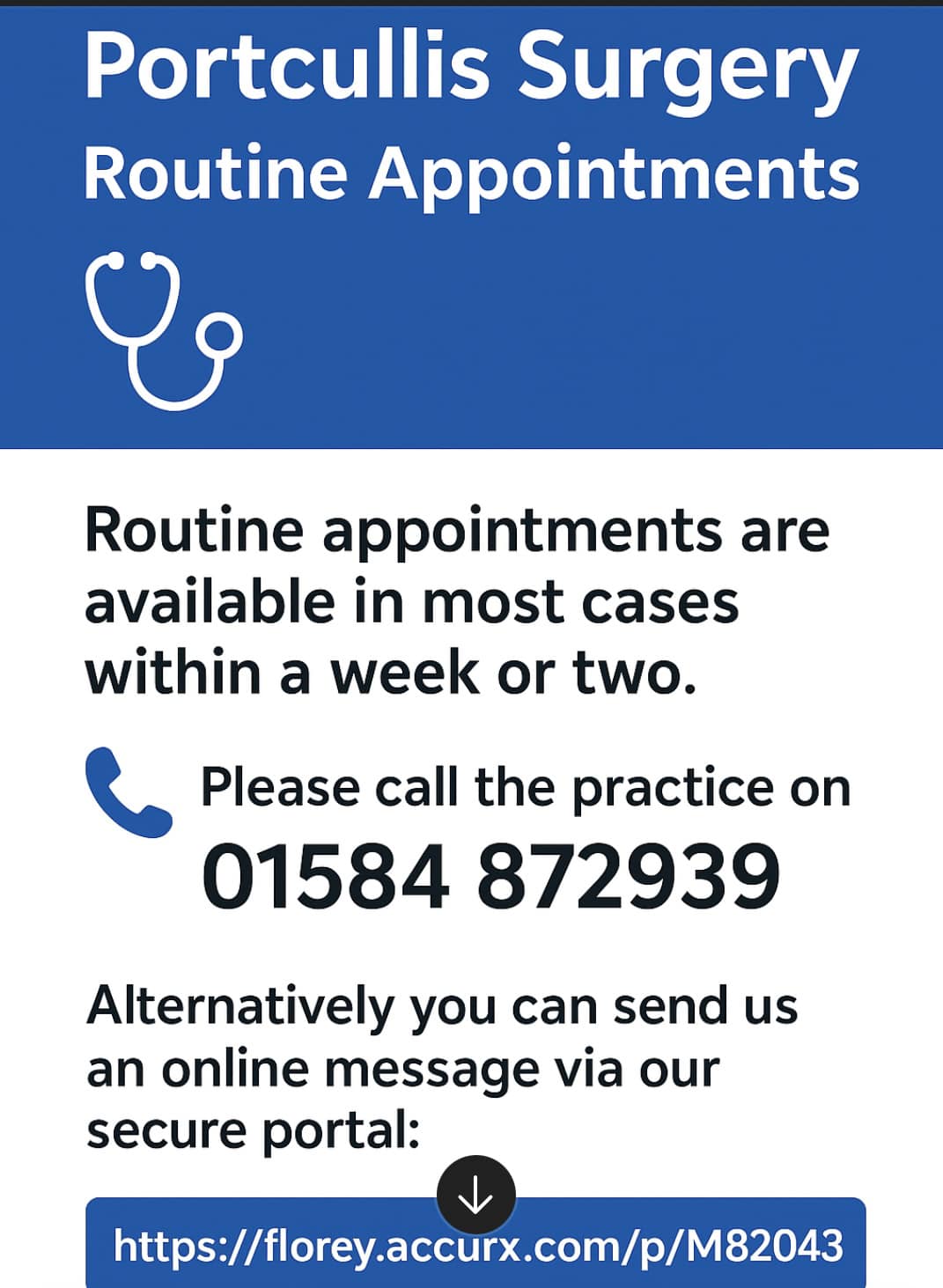
Send us an online message on the following link: https://florey.accurx.com/p/M82043 Online messages will be triaged and read by a member of the team on the same day and can be sent at anytime 24 hours a day and 7 days a week. Any messages sent after 6.30pm each afternoon may not be answered until the next working day. Messages sent on a Friday after 6.30pm may not be answered until the following Monday.
Or book or cancel appointments on the NHS App.
You can choose the way you contact your practice based on what is best for you.
What if the practice is closed?
If you need urgent help for your physical or mental health when the general practice is closed, and you cannot wait until they open, go online to 111.nhs.uk or call 111. They will tell you what to do next.
What if it’s an emergency?
If it’s a serious or life-threatening emergency, go straight to A&E (Accident and Emergency) or call 999.
Please note GPs are not a walk in service for emergencies or minor injuries.
In an emergency you should call 999 for an ambulance or travel to the nearest A and E in Shrewsbury or Hereford.
If you have suffered a minor injury you can go to Ludlow Minor Injuries Unit Monday to Sunday 8am to 8pm at Ludlow Community Hospital, Gravel Hill, Ludlow, Tel: 01584 872201
What happens when you contact your practice to request an appointment?
Whether you make your request by phone, on-line or visiting your practice, you may be asked to give your practice some details so that they can assess what is best for you based on your clinical need. The practice team will consider your non-urgent request for an appointment or medical advice and triage your request. -Send us an online message on the following link: https://florey.accurx.com/p/M82043 Online messages will be triaged and read by a member of the team on the same day and can be sent at anytime 24 hours a day and 7 days a week. Any messages sent after 6.30pm each afternoon may not be answered until the next working day. Messages sent on a Friday after 6.30pm may not be answered until the following Monday.
If your problem is URGENT (but not life-threatening ), then CALL the practiceON 01584 872939 a receptionist will add you to the DUTY CLINICIAN CALL BACK LIST and the Duty Clinician will call you back usually within a few hours.
This could be:
An appointment that day or a subsequent day
A phone call that day or a subsequent day
A text message responding to your query
Advice to go to another NHS service.
Portcullis Surgery will decide what is best for you based on your clinical need and we do not ask patients to just call back the next day. If we do run out of capacity we may call you back the next day if your call can wait.
We will always offer appointments with our clinicians first; “Practice first” and actively promote our patients to book with the same clinician who knows them so they can form lasting relationships with trusted clinicians; “Continuity First” especially our patients with long-term conditions
For any medical condition that is serious or persistent, a Doctor or Advanced Practitioner should always be your first point of contact.
Who might help you?
You might be offered a face-to-face appointment or a phone call with a GP or other member of the practice staff, like an advanced nurse or advanced paramedic.
If you have a carer, they can speak for you with your consent.
You can ask to see a preferred healthcare professional, and the practice will try to meet your request, although you might have to wait longer for that person to be available.
We will always offer appointments with our clinicians first; “Practice first” and actively promote our patients to book with the same clinician who knows them so they can form lasting relationships with trusted clinicians; “Continuity First” especially our patients with long-term conditions
From what age can you see a GP on your own?
If you are 16 or older, you can make and go to appointments by yourself.
If you are under 16, you can still ask to see a GP without your parent or guardian. The GP will decide if that’s appropriate for you.
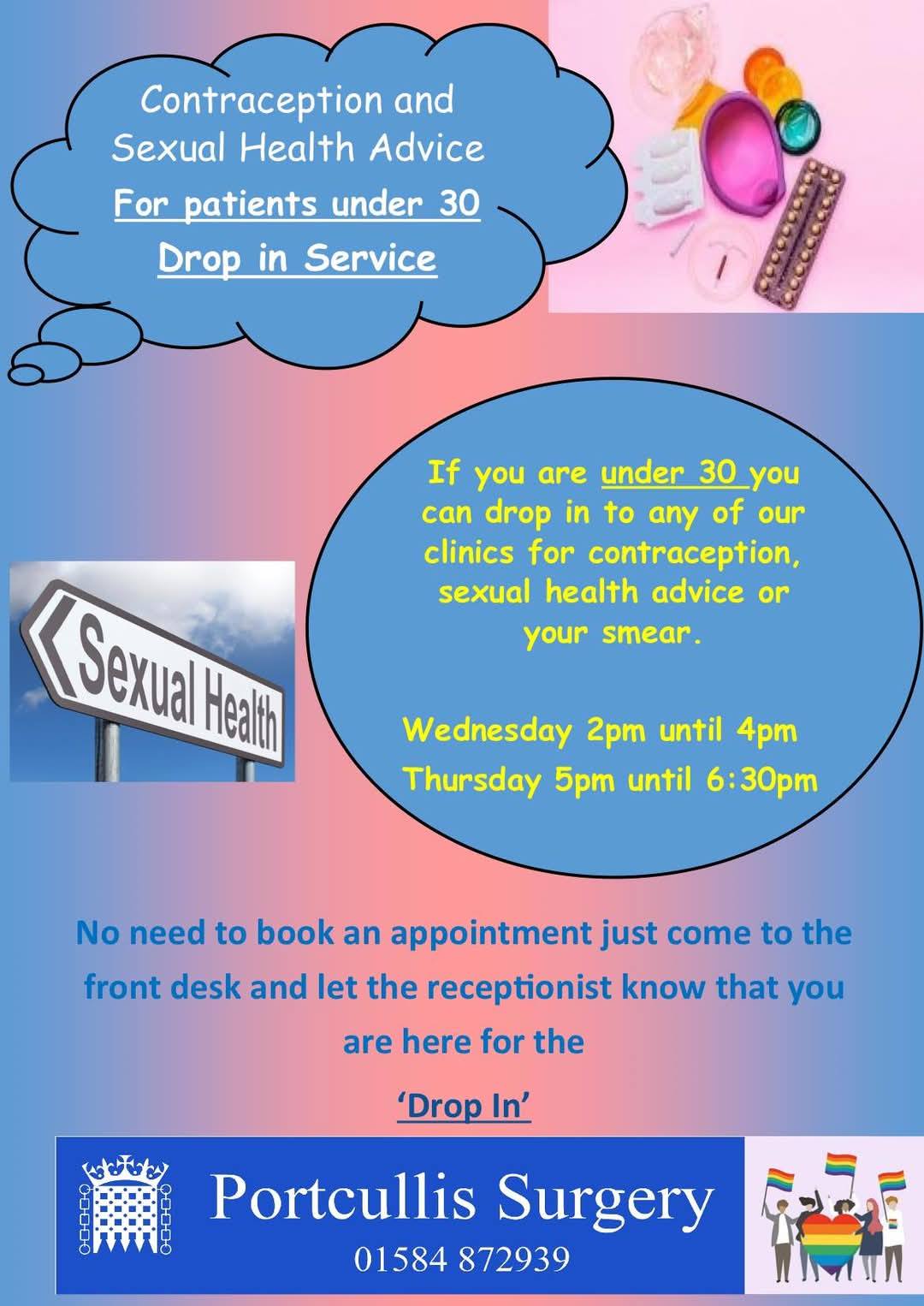
For your convenience we also have weekly drop-in nurse clinics on Wednesdays (2-4pm) and Thursdays (5-6.30pm) for young people to access help and advice about any medical matter including sexual health and general check ups, without the need for a pre-booked appointment.
This service is available for all our registered patients who are under 30 years of age. All you need to do is turn up and ask to be seen in the “drop in” clinic.
What if you need extra help?
If you do not speak English, you can ask for interpretation services in your preferred language when you make an appointment.
If you need extra help like longer appointments, a quiet space, wheelchair access, or information in a different format, tell your practice and they will try to help.
If you want to change to a new general practice you can do so at any point. Most people have a few choices nearby. We do accept patients outside of our boundary area as an Out of Area patient.
Portcullis Surgery has excellent access with 97.5% patients seen within 14 days of booking an appointment (average for all Shropshire practices is 89%)
This is reflected in our excellent patient satisfaction rate which is one of the highest in Shropshire with 91% of patients rating their overall experience as good (national average is 75%)
Portcullis Surgery waiting times are low and have been low for sometime, our staff have worked very hard to improve access over the past year. We have increased the number of appointments provided and currently offer an average of 671 appointments per 1000 patients at our practice which is one of the highest number of appointments per patient in Shropshire. (the average number of appointments offered by GP practices in Shropshire is 454 appointments per 1000 patients)
Do you need ID or proof of address?
No, you do not need ID, an NHS number or proof of address. It can help the practice if you do, but it is not needed to register or see a GP. You can also register with a practice if you are homeless.
Can a practice say no to registering you?
They must write to you within 14 days if they say no and explain why. A practice can only say no for a good reason, like if you live too far away or their patient list is closed. For example, they cannot say no for reasons such as immigration status, not having a permanent address, or for reasons connected with other characteristics protected under equalities legislation.
Can you choose which hospital or clinic you are referred to?
If your GP needs to refer you for a physical or mental health condition, in most cases you have the right to choose the hospital or service you’d like to go to. You can get further information on your right to choose on the nhs.uk website.
If you are new to the UK
You can still register with a GP. It’s free to use and your immigration status does not affect your right to register with a GP.
If you are away from home but still in the UK
If you are away from home for more than 24 hours (but less than 3 months), you can register as a temporary patient near where you’re staying.
You can also change your nominated pharmacy so you can get your medicine nearby. You can do this by contacting your practice or via the NHS App.
Do general practices charge for anything?
NHS GP services are free. Sometimes, if you ask the GP to do private work (like writing a letter for insurance), they may charge a fee.
How should everyone be treated?
The practice should treat everyone fairly, kindly and respectfully. Likewise, you should also treat staff with respect. The practice can remove patients from their list if they are violent or abusive to staff.
To learn more about your rights, you can read the NHS Constitution.
How can you help your general practice?
Be prepared: Before an appointment, think about writing down your symptoms, what you are worried about and what you want to talk about.
Be on time: Being late for an appointment or being unavailable for a timed call-back can affect other patients.
Cancel if needed: If you can’t go to your appointment, tell the practice as soon as you can, so that they can offer it to someone else.
Use the NHS App or website: If you’re confident using smart phones or computers, you can book or cancel appointments, order repeat prescriptions, and see your test results online.
Turn on notifications: If you use the NHS App, turn on notifications so the practice can contact you more easily. Please keep an eye out for messages.
Order repeat medicines on time: Make sure you ask for repeat prescriptions on time, so you don’t run out, and only order what you need.
Join the Patient Participation Group: You practice will have a group of patients who can offer feedback on the services it delivers. If you would like to join the Patient Participation Group please email our Duty Manager (portcullis.dutymanager@nhs.net) who will put you in contact with our Chair Alistair Barton.
How can you give feedback or raise concerns?
If you want to give feedback, raise a concern or wish to make a formal complaint, ask to speak to the practice manager. If you don’t feel comfortable doing this, contact your integrated care board (ICB) – the local NHS body that oversees GPs practices. You can find your local integrated care on the NHS England website.
You can also give feedback about your practice to your local Healthwatch. Their job is to make sure NHS leaders and other decision-makers hear your voice and use your feedback to improve care. Healthwatch is independent and impartial, and any information you share with them is confidential. To find your local Healthwatch visit the Healthwatch website.